01 - Calendar Starting Points
ME:lets compare timelines
Ch@:The starting dates below are different kinds of anchors. Some are traditional creation dates, some are political or religious epochs, and some are archaeological or reconstructed reference points. An epoch does not automatically prove that the people using the later calendar existed at that starting date.
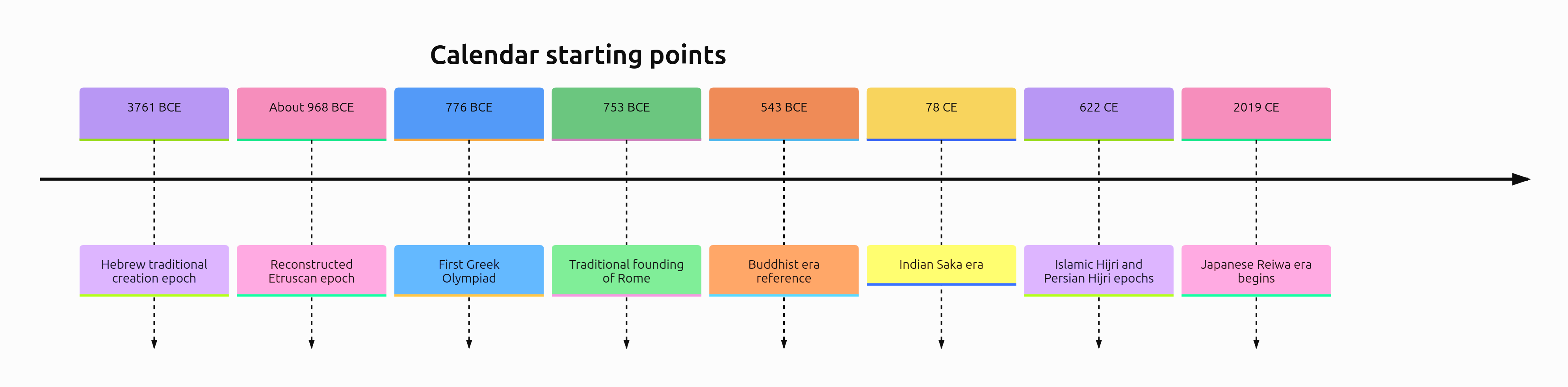
Calendar starting points: Hebrew epoch, reconstructed Etruscan reference, first Olympiad, Rome, Buddhist and Saka eras, Hijri epochs and Reiwa.
Ch@:
| Starting point | Meaning | Important distinction |
|---|---|---|
| 3761 BCE | Traditional Hebrew creation epoch | A calculated religious epoch, not the date when Jews first appear archaeologically. |
| About 968 BCE | Hypothetical reconstructed Etruscan reference | Not an authentic surviving continuous Etruscan year count. |
| 776 BCE | Traditional first Greek Olympiad | A four-year historical counting framework, not one national Greek civil calendar. |
| 753 BCE | Traditional founding of Rome | Basis of later AUC reckoning. |
| 543 BCE | Buddhist Era reference | Used differently across Buddhist countries. |
| 78 CE | Indian Saka era | Basis of India's national civil calendar. |
| 622 CE | Islamic and Persian Hijri epochs | The Islamic calendar is lunar; the Persian Solar Hijri calendar is solar. |
| 2019 CE | Japanese Reiwa era begins | Era years follow the emperor's reign. |
02 - What Year Is It?
ME:What year is it now according to the ancient Greek calendar
Ch@:Ancient Greece had several local calendars, so there is no single ancient Greek year. Using the common Olympiad framework, November 8, 2026 falls in Year 2 of the 701st Olympiad. The cycle begins with the traditional first Olympic Games in summer 776 BCE. In an Athenian reconstruction, the civic year began around the first new moon after the 2026 summer solstice. Greeks normally identified a year by an official such as the ruling archon rather than by one universal increasing number.
ME:How about ancient rome
Ch@:Using Rome's traditional ab urbe condita system - "from the founding of the city" - 2026 CE is 2779 AUC. This uses the traditional foundation date of 753 BCE. Romans usually named the year for the two serving consuls. January 1 became the civil New Year in the later Republic.
ME:And etruscan?
Ch@:There is no reliable Etruscan equivalent of 2026. The Etruscans did not leave a known continuous count like Roman AUC. They divided historical time into saecula, variable sacred ages associated with human generations. Extending a reconstructed reference around 968 BCE would produce approximately 2993, but that is a modern calculation rather than authentic Etruscan dating.
ME:So the straightforward Etruscan answer?
Ch@:Approximately Etruscan year 2993 only if we deliberately use the hypothetical 968 BCE reconstruction. The historically careful answer is that no exact continuous Etruscan year survives.
03 - Same Day Across the Calendars
ME:let sfocus on th egreek calendar and roman calendar and etuscan calendar lets compare timelines and comare them against the oriental calendars and the muslim moon calendar like serbia uses sorta
Ch@:The important distinction is that some calendars count solar years, some lunar years, and others combine lunar months with solar corrections. Serbia does not use the Muslim lunar calendar. Serbia uses the Gregorian calendar for civil life, while the Serbian Orthodox Church generally retains the Julian calendar for fixed feast dates.
Ch@:
| Calendar | November 8, 2026 comparison | System |
|---|---|---|
| Greek Olympiad | Year 2 of the 701st Olympiad | Four-year historical cycle beginning in summer 776 BCE |
| Roman AUC | 2779 AUC | Solar civil year counted from traditional Rome foundation |
| Reconstructed Etruscan | About 2993 | Modern extension from a hypothetical reference |
| Serbian civil | November 8, 2026 | Gregorian solar calendar |
| Serbian Orthodox | October 26, 2026 | Julian calendar; currently 13 days behind Gregorian |
| Islamic Hijri | Approximately 28 Jumada al-Awwal 1448 AH | Pure lunar calendar; local observation can shift one day |
| Persian Solar Hijri | 17 Aban 1405 | Solar calendar anchored to the spring equinox |
| Chinese traditional | Fire Horse year; ninth lunar month | Lunisolar |
| Hebrew | 28 Heshvan 5787 | Lunisolar |
| Thai Buddhist | 2569 BE | Solar civil calendar numbered from a Buddhist era |
| Indian Saka | 17 Kartika 1948 | Indian national solar civil calendar |
| Japanese | Reiwa 8 | Gregorian year organized by imperial reign era |
ME:What is the closest relationship between all of them?
Ch@:
- Greek, Roman, Etruscan and Serbian traditions are strongly solar or seasonal.
- The Islamic Hijri calendar is completely lunar.
- Chinese and Hebrew calendars use lunar months plus leap adjustments that keep festivals in their solar seasons.
- The Persian calendar is highly accurate and solar even though it shares the 622 CE Hijra epoch.
- Indian traditions combine solar, lunar and regional systems.
04 - Astrological Signs and New-Year Transitions
ME:can you give me the astrological signs fo reach an dany other important harvest dates an dother new transition dates for each
Ch@:Using November 8, 2026 as the comparison date, the Western tropical sign is Scorpio. That sign can be translated into Greek and Roman settings, but it should not be treated as an official sign of every calendar. Religious calendars and astrology are separate systems.
Ch@:
| Calendar | Astrological designation | New-year transition | Harvest or seasonal observance |
|---|---|---|---|
| Ancient Greek | Skorpios / Scorpio | Attic year after the first new moon following summer solstice | Thargelia: first grain and start of harvest |
| Roman | Scorpio | January 1 in later Republic; earlier year associated with March | Cerealia, Vinalia, Consualia, Opiconsivia and Vertumnalia |
| Etruscan | Greek zodiac later adopted; indigenous divination emphasized omens and sacred sky regions | Exact civic New Year uncertain; historical time divided into saecula | Agricultural rites existed, but exact fixed dates are poorly preserved |
| Serbian civil | Scorpio | January 1 Gregorian | Modern agricultural calendar |
| Serbian Orthodox | Astrology is not part of the church calendar | January 14 Gregorian corresponds to January 1 Julian | Durdevdan, Ivanjdan and Preobrazenje mark seasonal traditions |
| Islamic Hijri | No official religious astrological sign | 1 Muharram 1448 AH around June 16-17, 2026 | No permanently fixed harvest season because dates migrate |
| Persian Solar Hijri | Aqrab / Scorpio for the comparison date | Nowruz at the spring equinox | Mehregan: autumn harvest and thanksgiving |
| Chinese | Fire Horse year | Chinese New Year, February 17, 2026 | Qingming, 24 solar terms and Mid-Autumn Festival |
| Hebrew | Akrav / Scorpio traditionally associated with Heshvan | Rosh Hashanah begins the year | Passover barley, Shavuot wheat/first fruits, Sukkot ingathering |
| Indian / Vedic | Western Scorpio; sidereal solar position differs | Several regional New Years; Saka year near March 22 | Makar Sankranti/Pongal, Vaisakhi, Onam and regional Diwali harvest links |
| Thai Buddhist | Western Scorpio; Chinese-style animal Horse | Songkran April 13-15; civil year January 1 | Rice-cycle ceremonies and Loy Krathong |
| Japanese | Western Scorpio; traditional animal Horse | January 1; Reiwa 8 | Niinamesai new-rice thanksgiving, November 23 |
05 - Agricultural and Sacred Seasonal Cycles
ME:What were the important Greek harvest transitions?
Ch@:
- Hekatombaion: civic year after the summer solstice.
- Pyanepsion: autumn sowing and seed offerings.
- Poseideon: winter transition.
- Anthesterion: new wine opened around February-March.
- Thargelion: first grain and purification before harvest.
- Skirophorion: closing month before the next year.
ME:What were the Roman agricultural dates?
Ch@:
- April 12-19 - Cerealia: Ceres and growing grain.
- April 23 - Vinalia Priora: opening or blessing of wine.
- April 25 - Robigalia: protection of grain from rust disease.
- Late May - Ambarvalia: purification of fields.
- August 19 - Vinalia Rustica: approaching grape harvest.
- August 21 - Consualia: harvested grain and storage.
- August 25 - Opiconsivia: abundance and storing the crop.
- Autumn - Vertumnalia: fruit, gardens and seasonal transformation.
ME:What made Etruscan transitions different?
Ch@:Etruscan priests divided the heavens into sacred regions. Lightning, birds and unusual events could announce transitions. Civilization itself was divided into successive saecula. A saeculum was said to end when the last person born at its beginning had died, and divine signs announced the next age. An Etruscan "great transition" could therefore mean the close of a sacred age rather than an ordinary annual New Year.
ME:Why does the Islamic calendar not have fixed harvest dates?
Ch@:The Hijri year is about 10-11 days shorter than the solar year. Muharram, Ramadan and the pilgrimage move backward through all solar seasons. Islamic religious dates follow the Moon even though historical Islamic astrology used the solar zodiac.
ME:What are the main Chinese transitions in 2026?
Ch@:
- February 17 - Fire Horse year begins.
- March 3 - Lantern Festival.
- April 5 - Qingming.
- June 19 - Dragon Boat Festival.
- September 25 - Mid-Autumn Festival.
- October 18 - Double Ninth Festival.
- December 22 - Dongzhi / winter solstice.
06 - Troy, Israel, the Dead Sea Scrolls and 3761 BCE
ME:was troy founded before jew?
Ch@:Troy was founded long before Jews emerged as a historically identifiable people. The earliest fortified settlement at Troy dates to about 3000 BCE. Troy VI-VII, associated with Trojan War traditions, dates roughly 1700-1180 BCE. The earliest widely accepted external written reference to Israel is the Merneptah Stele around 1207 BCE. Distinct Jewish/Judahite identity developed later, especially through the first millennium BCE.
Ch@:
| Event | Approximate date |
|---|---|
| First fortified settlement at Troy | 3000 BCE |
| Troy VI-VII and Trojan War tradition | 1700-1180 BCE |
| Earliest external evidence naming Israel | About 1207 BCE |
| Kingdoms of Israel and Judah | About 1000-930 BCE onward |
| Major development of recognizable Jewish/Judahite identity | First millennium BCE, especially after the Babylonian exile |
ME:check th edead sea scrolls
Ch@:The Dead Sea Scrolls do not show that Jews predated Troy. Most scroll manuscripts date from about the third century BCE through the first century CE. They preserve older biblical traditions, but they are copies from the Second Temple period, not documents written in the age traditionally assigned to Abraham.
Ch@:
- Troy's first fortified settlement: about 3000 BCE.
- Earliest independently recorded Israelites: about 1207 BCE.
- First Temple period: traditionally about 960-586 BCE.
- Dead Sea Scroll manuscripts: mainly about 300 BCE-68 CE.
- Great Isaiah Scroll: about 125 BCE.
- Some Genesis and Deuteronomy fragments: late centuries BCE.
ME:in th etimeline jhebrew is 3761 bc thats older than yo ujust said
Ch@:You are correct that the Hebrew calendar epoch, 3761 BCE, is earlier than Troy's archaeological founding around 3000 BCE. The two dates describe different things. 3761 BCE is a later calculated date for Creation. It is not the archaeological date when the Hebrew people or Judaism first appeared.
Ch@:
| Date | Meaning |
|---|---|
| 3761 BCE | Hebrew calendar's calculated Creation epoch |
| About 3000 BCE | Archaeological founding of the settlement at Troy |
| About 1207 BCE | Earliest external written evidence identifying Israel as a people |
| 600s-500s BCE | Major development of recognizable Jewish/Judahite identity |
| About 900-1000 CE | The calculated Hebrew calendar reached essentially standardized form |
ME:So which one is older?
Ch@:
Calendar epoch: the Hebrew 3761 BCE Creation epoch is earlier than Troy.
Historically documented settlement or people: Troy around 3000 BCE predates the earliest independent evidence for Israel by roughly 1,800 years.
07 - What Year Is China In?
ME:and what year did th echinese recently find out they are in?
Ch@:The traditional designation is Bingwu (丙午), the Fire Horse year. If converted into a continuous Yellow Emperor count, 2026 may be called year 4723 or 4724 depending on whether the epoch is placed in 2697 or 2698 BCE.
ME:Did China recently discover that it was year 4724?
Ch@:No. Traditional Chinese chronology normally identified years by an emperor's reign, a repeating sixty-year stem-and-branch cycle, and the animal-element combination. The continuous 4700-range Yellow Emperor numbering was promoted in the early twentieth century rather than inherited as one unbroken ancient civil count.
Ch@:
Neither an epoch nor a projected year number proves that the corresponding people or calendar system already existed in that starting year.
| Calendar | Current expression | Claimed or traditional epoch |
|---|---|---|
| Chinese traditional | Bingwu, Fire Horse | Cyclical; not normally one continuous number |
| Yellow Emperor count | 4723 / 4724 | About 2697 / 2698 BCE |
| Hebrew Anno Mundi | 5787 | Traditional Creation epoch, 3761 BCE |
| Etruscan reconstruction | About 2993 | Hypothetical reference about 968 BCE |
| Roman AUC | 2779 | 753 BCE |
| Islamic Hijri | 1448 AH | 622 CE |
08 - Month Names and the Interactive Atomic Calendar
ME:can i have th enames of all the months in all these culture as well
Ch@:Attic Greek: Hekatombaion, Metageitnion, Boedromion, Pyanepsion, Maimakterion, Poseideon, Gamelion, Anthesterion, Elaphebolion, Mounichion, Thargelion and Skirophorion.
Roman: Ianuarius, Februarius, Martius, Aprilis, Maius, Iunius, Quintilis/Iulius, Sextilis/Augustus, September, October, November and December.
Hebrew: Nisan, Iyar, Sivan, Tammuz, Av, Elul, Tishrei, Heshvan, Kislev, Tevet, Shevat and Adar; leap years add Adar I and Adar II.
Islamic: Muharram, Safar, Rabi I, Rabi II, Jumada I, Jumada II, Rajab, Shaban, Ramadan, Shawwal, Dhu al-Qidah and Dhu al-Hijjah.
Ancient Greek month names varied by city. A complete fixed Etruscan month list is not securely reconstructed.
This focused edition incorporates the useful material from the supplied calendar writings and removes duplicated tables, exported diagram code, unrelated material and repeated filler.