INTERACTIVE WEBPAGE
HTML / CSS / JS; contains the reading room, active diagrams, exchange simulation, and a configurable home security worksheet.
DOWNLOAD HTMLFrom a storage module that drains into another to mainframe security, industrial networks and a fortified smart home. Interactive research and working design notes.
ME: are their types of programs that leave one system as its entering another. not copy and delete but where the data is drained from one to the other storage module?
ME: how could the current mainstream data superexchange which occurs daily become more secure from these variations of memory exchange? from implementation of this type of technologies which further than the current protocols are being explored at the moment ? in corporate and industrial applications as well as mainframe systems for data exchange between homeowners and smarthome technologies? what are some examples of whats being implemented now and whats to come and how can data exchange for our hoem fortresses become fortifications and stripped down exchanges better?
A conversation-to-document edition based on the exchange beginning with the user's drain-and-fill memory question on 22 November 2026. Includes discussion of enterprise data exchange, cloud and mainframes, industrial communication, and residential "home fortress" design. Both original user questions are preserved verbatim; assistant responses are edited into topical chapters for clarity, rather than represented as a word-for-word transcript.
HTML / CSS / JS; contains the reading room, active diagrams, exchange simulation, and a configurable home security worksheet.
DOWNLOAD HTMLClickable chapter bookmarks, thumbnail index, external references and fillable planning fields.
OPEN / DOWNLOAD PDFDOCX with navigable chapter headings, image figures, source hyperlinks, and editable planning worksheet.
OPEN / DOWNLOAD DOCXFor electrolips.online publish the entire folder without renaming index.html or the files/ and images/ directories. All resources work together locally or on IONOS.
The discussion begins with a distinction between copying a file and moving a quantity of stored information from one place to another. The proposed behavior resembles liq...
Streaming migration: small chunks are sent sequentially, allowing bounded memory use, checksums and progress tracking. A copy may temporarily exist at both ends until ack...
Modern data exchange routinely passes through devices, message brokers, applications, cloud storage, caches, diagnostic logs and third-party services. Every new persisten...
Zero trust (NIST SP 800-207): policies and authentication apply to access requests; inside-network status is not sufficient authorization....
Hardware-verified receiving memory: the sender verifies the destination environment or enclave using attestation before releasing a secret or decryption key. Attestation ...
A house should be modeled more like a small industrial control system than a collection of unrestricted cloud appliances. Put IoT equipment on a separate network from per...
1. Segment devices. Place cameras, lights, appliances and cheap network modules on separate VLANs or SSIDs with firewall rules denying unsolicited access to household com...
A water sensor can report only a device identifier, event type, boolean state, message identifier and short expiration interval. The actual transport must supply authenti...
A data diode allows information to travel in only one physical direction. Industrial and high-security sites use such separation when a protected network should publish l...
Mainframes: broader cryptographic protection of stored and transmitted records, modernization of key management, gradual post-quantum migration, and more detailed access ...
This is a concept proposal rather than a currently certified product. A module between private devices and an external network would accept only authenticated, purpose-li...
A modern home does not need to explain itself constantly to every manufacturer of every appliance it contains. Its locks should not share a network privilege with its ent...
All three diagrams are included as full-resolution PNG and scalable SVG files. Select a thumbnail to expand the drawing.
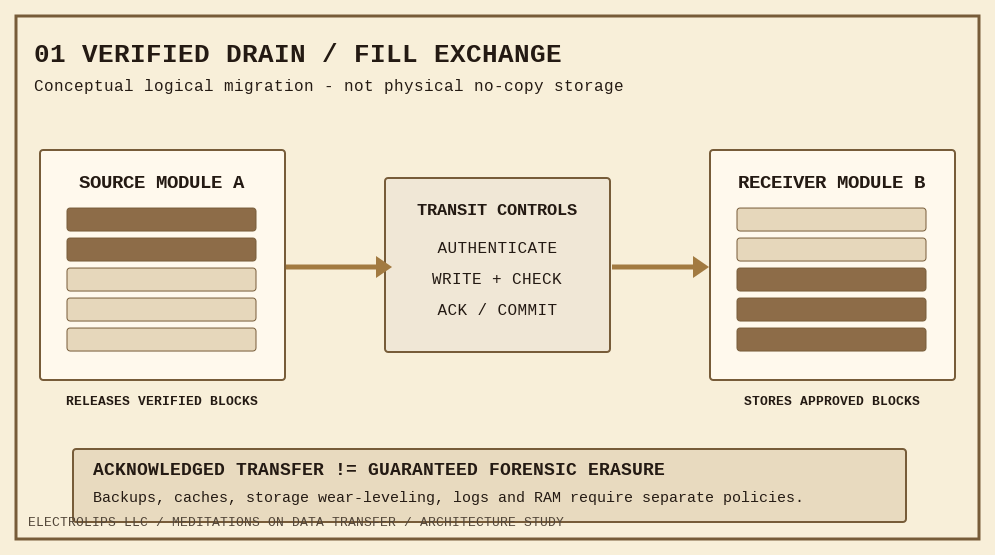
Move the slider to model progressive delivery and release of blocks. This is a logical simulation: the bytes are written to the receiver before the sender's accessible blocks are released. It does not represent proof of destruction.
The discussion begins with a distinction between copying a file and moving a quantity of stored information from one place to another. The proposed behavior resembles liquid draining out of one vessel as another fills. In computing, the closest equivalents depend on whether the discussion concerns logical ownership, message processing, physical electrical states or stored bytes.
Streaming migration divides a dataset into blocks and processes them progressively. An acknowledged consumer removes a completed work item from its active queue after successful processing. Zero-copy systems can move responsibility for a shared memory buffer without duplicating its payload. Charge-coupled devices (CCDs) physically shift packets of charge between adjacent potential wells, but CCD charge transfer is not a drop-in replacement for SSD-to-SSD data migration.
A practical verified migration uses the sequence: READ BLOCK -> AUTHENTICATE RECIPIENT -> WRITE -> VERIFY -> COMMIT -> ACKNOWLEDGE -> RELEASE SOURCE SPACE. Conventional storage still performs reads and writes; it can also preserve hidden copies in caches, logs, backups, snapshots and storage-controller remapping layers.
The defensible insight is to make transfer transactional, purpose-limited and observable, not to promise that the exact same bits have physically traveled without duplication.
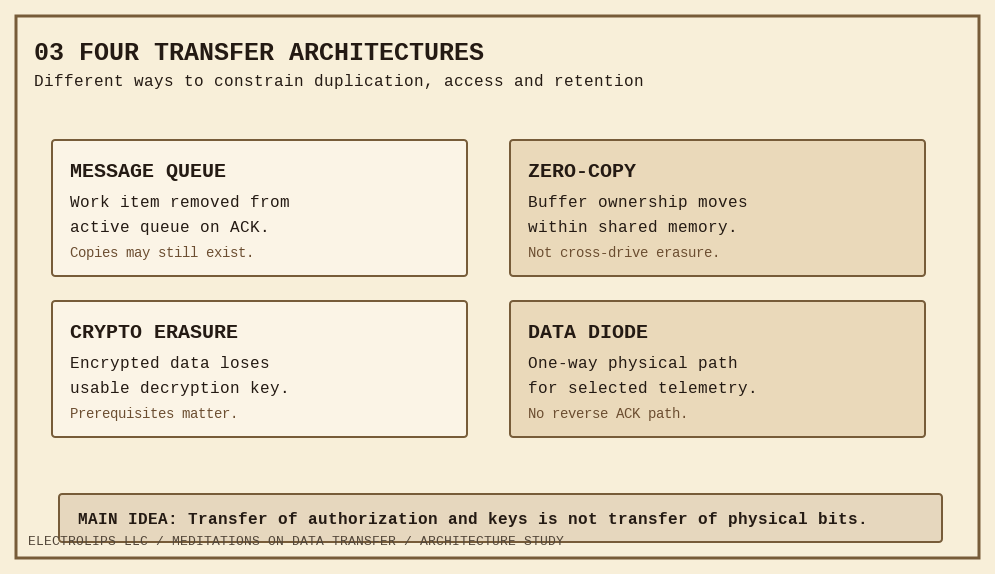
Streaming migration: small chunks are sent sequentially, allowing bounded memory use, checksums and progress tracking. A copy may temporarily exist at both ends until acknowledgment and cleanup.
Destructive-read or work-queue semantics: some systems remove a work item from an active queue after confirmed handling. In cloud queues, acknowledging or deleting a message does not prove removal of every replica, backup or downstream record. In NATS JetStream, retention policy controls when acknowledged messages are actually removed.
Zero-copy ownership transfer: a process can hand an existing buffer or a reference to another process without copying the data bytes. This reduces duplicate memory allocations but generally requires shared memory or an operating-system mechanism; it is not proof of permanent deletion.
Charge-transfer storage: CCD structures move packets of charge between wells under clocked electric fields. This is a genuine physical transfer analogy. Engineering a robust general-purpose nonvolatile memory or long-distance data channel from this principle requires further design and evidence.
Modern data exchange routinely passes through devices, message brokers, applications, cloud storage, caches, diagnostic logs and third-party services. Every new persistent copy can extend the attack surface and make retention policy harder to enforce.
The goal is not merely stronger encryption. It is reducing what is collected, tightly defining who may receive it, ensuring that each requested action is necessary, and limiting how long records survive.
Zero trust requires decisions about access to resources regardless of presumed network location. It is especially important for connected homes because a cheap appliance should not gain broad privilege merely by joining the same wireless network as the owner's computer.
BACK TO CONTENTS ↑Zero trust (NIST SP 800-207): policies and authentication apply to access requests; inside-network status is not sufficient authorization.
Acknowledged messaging (Amazon SQS, NATS JetStream): receiving and processing are distinct from successful deletion. Acknowledgments, retries, deduplication and retention policies govern reliability and lifecycle.
Confidential computing: hardware-backed protected environments can limit what the host operating system or outside operators can read while a workload processes sensitive data; attestation helps a sender decide whether a receiving workload is acceptable.
Mainframe security: pervasive encryption and hardware cryptographic protections reduce exposure of data at rest and in transit. Enterprises are also planning cryptographic agility and migration to NIST-standardized post-quantum algorithms.
Industrial control: OPC UA offers configurable application identity, authentication, signatures and encrypted communication between machines and software.
Smart homes: Matter provides interoperable authenticated commissioning and encrypted communication for supported devices. Local-first controllers can allow many functions to run without constant cloud dependencies; actual cloud independence depends on each device and integration.
BACK TO CONTENTS ↑Hardware-verified receiving memory: the sender verifies the destination environment or enclave using attestation before releasing a secret or decryption key. Attestation improves confidence but does not prove that malicious authorized code will never misuse data.
Consumable encrypted messages: a recipient receives only a scoped token or a message that expires quickly; once the intended operation completes, the system discards the temporary decryption material and stops delivering retries.
Cryptographic erasure: information encrypted with sound keys may be rendered inaccessible when every effective copy of its decryption keys is destroyed. The validity of this claim depends on key custody, backups, device support, media state and sanitization guidance.
Constrained-device object security: OSCORE protects application messages to and from limited IoT devices, and can preserve content protection across certain intermediary systems.
Post-quantum cryptography: NIST has standardized algorithms and organizations are beginning staged migrations. Quantum-resistant encryption does not eliminate device compromise, credential theft, malicious firmware or unnecessary data collection.
These changes are complementary, not interchangeable. A secure design should authenticate the other end, minimize data, encrypt during transmission, confirm delivery and enforce retention limits.
BACK TO CONTENTS ↑A house should be modeled more like a small industrial control system than a collection of unrestricted cloud appliances. Put IoT equipment on a separate network from personal computers, administrative credentials and sensitive documents.
The central controller should remain locally reachable whenever the devices permit it. Door locks, safety alarms and essential switching must have reliable local or manual fallback. Remote functions should not be able to disable safety protections casually.
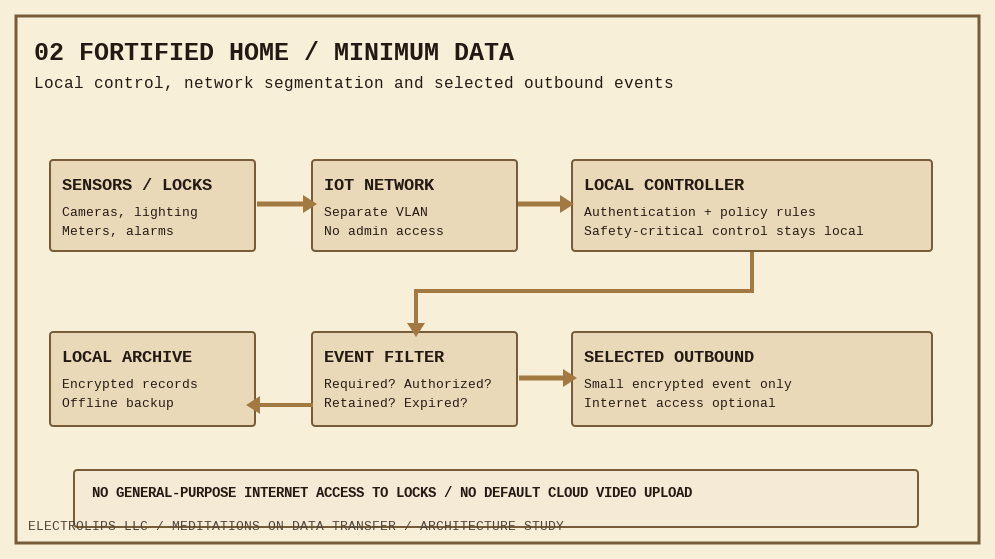
Proposed path: SENSORS / LOCKS -> ISOLATED IOT NETWORK -> LOCAL CONTROLLER AND POLICY ENGINE -> NECESSITY CHECK -> MINIMAL ENCRYPTED EVENT -> AUTHORIZED RECEIVER. An encrypted local event archive and offline recovery backups form a separate branch.
Minimize telemetry. A leak sensor needs to say that a leak was detected; it does not ordinarily need to upload full logs of household activity. A camera may detect motion locally and transmit only an alert, while retaining selected recordings locally according to policy.
1. Segment devices. Place cameras, lights, appliances and cheap network modules on separate VLANs or SSIDs with firewall rules denying unsolicited access to household computers and administrative consoles.
2. Favor local operation. Select compatible local-first devices and check whether they continue to work without the vendor's cloud.
3. Send events instead of continuous surveillance. Keep full data only where it is needed and justified.
4. Limit permissions per device. A thermostat cannot read camera recordings; a lighting controller cannot unlock doors.
5. Authenticate sensitive commands. Use device identities, encryption, short expiry, message identifiers, replay defenses and additional controls for high-impact actions.
6. Define retention and disposal. Remove unnecessary transient records, preserve required audit events and protect backups. Acknowledgment is not a reliable proof of forensic erasure.
7. Preserve independent recovery. Use offline backups, update policies, physical overrides for essential systems, and a verified plan for power and internet outages.
BACK TO CONTENTS ↑A water sensor can report only a device identifier, event type, boolean state, message identifier and short expiration interval. The actual transport must supply authenticated encryption and replay protection; a small JSON object by itself does not secure a network.
Example message: {"device":"water_sensor_07","event":"leak_detected","value":true,"expires_in_seconds":15,"message_id":"000184"}.
A locally authorized controller can activate a shutoff valve, log the event, and acknowledge the operation. If remote notification is wanted, it should be a separate selective outbound event. A real design also needs safeguards for duplicate events, connectivity failures and physical valve state.
BACK TO CONTENTS ↑A data diode allows information to travel in only one physical direction. Industrial and high-security sites use such separation when a protected network should publish limited telemetry but should not receive arbitrary inbound traffic.
A fortified house could publish selected environment or alarm events through a one-way boundary. Door locks, electrical switching and security controllers can remain on an isolated internal network.
A one-way channel cannot receive an acknowledgment back along that same physical path. Systems requiring reliable acknowledgments must provide an appropriately designed separate path or use a bidirectional authenticated protocol. This tradeoff must be stated, not hidden.
BACK TO CONTENTS ↑Mainframes: broader cryptographic protection of stored and transmitted records, modernization of key management, gradual post-quantum migration, and more detailed access controls around database services.
Cloud and corporate systems: confidential virtual machines, remote attestation, protected private computation and stronger policy checks on which workloads may receive data.
Industrial systems: authenticated machine-to-machine exchanges, segmented plant networks, OPC UA security policies, local processing and specialized unidirectional gateways where operationally appropriate.
Residential systems: greater interoperability through Matter, secure commissioning, local decision-making, less default cloud sharing, and device-scoped permissions. Deployment varies greatly between manufacturers.
An open research question is whether transfer-bound ownership can be standardized: a receiving environment would receive a short-lived capability to decrypt or act on a dataset, while the source system would revoke its capability after a verifiable committed transfer.
BACK TO CONTENTS ↑This is a concept proposal rather than a currently certified product. A module between private devices and an external network would accept only authenticated, purpose-limited requests; apply explicit policy; issue short-duration transfer rights; encrypt the payload; record a non-sensitive audit trace; and expire or revoke access after a defined operation.
A secure design should separate payload data from identity metadata where practical. It should never claim absolute destruction without testing the actual underlying memory, backup, key and logging paths.
Potential implementation layers: a hardware-backed identity and secure boot; a minimal policy engine; encrypted message queues; network segmentation; device-specific authorization; an independently protected event log; and a recovery procedure that cannot be triggered by an unauthenticated remote request.
Success measures include data volume released per event, number of devices with broad privileges, cloud dependencies, unauthorized reachability, mean update latency, event-delivery correctness and recoverability after a device compromise.
BACK TO CONTENTS ↑A modern home does not need to explain itself constantly to every manufacturer of every appliance it contains. Its locks should not share a network privilege with its entertainment devices. Its lights should not become a general-purpose microphone for third parties. Its essential controls should remain useful when the outside network disappears.
Stripping down an exchange is not primitive engineering. It is selecting the narrowest useful statement: a valve closed; a temperature crossed a threshold; a door was opened by an authorized person. Everything beyond the necessary event must justify its cost in power, storage, privacy, and risk.
To move data responsibly is to define not just its destination, but the conditions of its arrival, the authority of its recipient, its expiry, and the evidence that the transfer completed. The strongest residential fortress may be the one that transmits the least.
BACK TO CONTENTS ↑Select controls you want in your design; the page builds a copyable local security plan. It does not contact a server.
Select controls, then generate your security plan.
Official specifications and vendor documentation. The original conversation informed the questions and architecture; these external references support the standards descriptions and limits.
Illustrated diagrams are conceptual. Do not infer that any untested architecture provides complete confidentiality, guaranteed deletion, verified isolation, or certification.